




Email: sales@fsain.com.cn
Phone: +86-0571-85101359
Analysis of Drone Interference
2025-11-07
Table of Content
[Hide]
Analysis of interference devices: Interference methods and interference results
Introduction
As a crucial means of low - altitude security defense, the effectiveness of unmanned aerial vehicle (UAV) interference technology not only depends on the performance of the equipment but also on the precise control of key aspects. This paper conducts a systematic analysis of UAV interference equipment, focusing on two core issues. Firstly, the identification of interference targets and the selection of communication links, that is, how to accurately distinguish and effectively jam the remote - control, video - transmission, and navigation links. Secondly, the effects presented after the interference is initiated.
The working principle of unmanned aerial vehicle (UAV) interference equipment
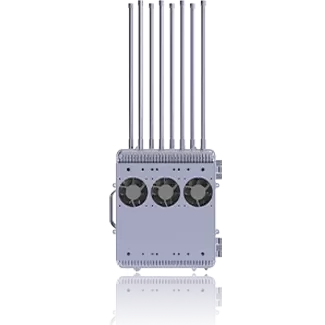
The working principle of unmanned aerial vehicle (UAV) interference devices can be summarized as follows: By transmitting strong interference signals with the same frequencies as the UAV's communication and navigation frequencies, it disrupts the UAV's control link, video transmission link, and navigation link. Advanced anti drone jammer solutions and related drone jammer technologies can be integrated into C-UAS protection strategies to provide controlled countermeasures for unauthorized UAV threats, causing the drone to lose control or be unable to locate itself, thereby triggering safety mechanisms such as returning to the home point, hovering, or making an emergency landing.
I. Interfere with the target link
Link Type | Conventional frequency band range | Interference Mode |
Remote control link | 2.4 GHz / 5.8 GHz / 900 MHz | Block the uplink control signals to prevent the unmanned aerial vehicle (UAV) from receiving instructions. |
Image transmission link | 5.8 GHz / 1.4 GHz / 2.4 GHz | Interfere with the downlink video/data transmission, rendering the operator "blind". |
Navigation link | GPS L1/L2 / BDS B1 / GLONASS L1/ GALILEO E1 | Sending false or suppressed signals to cause the unmanned aircraft to lose its positioning capability |
II. Interference Modes
1. Barrage Interference
High - power white noise or continuous waves are transmitted within the target frequency band to cover the entire band, resulting in an extremely low signal - to - noise ratio at the receiver and making it impossible to demodulate useful signals.
2. Spot Interference
Power is concentrated on the specific frequency points used by the unmanned aerial vehicle (UAV), such as 2.412 GHz. This mode is more efficient and suitable for scenarios where the protocol or frequency - hopping sequence is known.
3. Spoofing
Forged GPS/Beidou signals are transmitted to induce the UAV to calculate an incorrect position, triggering the return - to - base or yaw function.
4. Sweep Interference
Periodically scan within the target frequency band at a rate higher than the frequency hopping dwell time to form an "intermittent - blocking" coverage, without the need to pre - know the specific frequency hopping sequence. When the scanning repetition period is much shorter than the single - frequency dwell time, it can produce a statistical suppression effect on medium - and low - speed frequency hopping systems. For high - speed frequency hopping systems (>1000 hop/s) or systems with an extremely large number of channels, broadband blocking or tracking interference should be used instead.
III. System Composition
- Interference Module: Power amplifier, frequency source, antenna (directional/omnidirectional)
- Control Unit: Set the interference frequency band, power, and mode.
- Power Supply System: Battery or mains power.
IV. Typical Workflow
1. The detection device discovers the drone → Identify the model and frequency band.
2. The interference device is started automatically or manually and aimed at the target direction.
3. Transmit interference signals to block the remote control/video transmission/navigation links.
4. The drone enters the fail - safe mode (Return - to - Home / Hover / Land).
V. Notes
- Interference navigation signals may affect not only drones but also surrounding GPS devices. Use with caution.
- Different countries have strict legal restrictions on the use of interference devices. Usually, only the military, police, or critical infrastructure are authorized to use them.
Summary: Drone interference devices cut off the three essential links for drones' operation through the means of "electromagnetic shielding", which is an efficient and non - kinetic countermeasure.
Effect chains will emerge in the target area:
1. The spectrum analyzer shows a "fully red screen".
The background noise in the target frequency band instantaneously increases by 30 - 60 dB, causing the useful signals to be "submerged". The spectrum exhibits continuous broadband spikes or flat - topped peaks.
2. Receiver "Loss of Lock" Alarm
- UAV Remote Control: The signal strength bar returns to zero.
- GPS Receiver: The HDOP value fluctuates abruptly. More than 80% of the satellites are lost on the satellite map, and some chips report "GPS No Fix".
- Wi-Fi Video Transmission: The screen freezes, shows a mosaic, or goes completely black, and the bit rate drops to 0 Mbps.
3. Abrupt Changes in Drone Behavior
- When the 2.4 / 5.8 GHz remote control is interfered the drone hovers for 3 - 5 seconds and then triggers the Return - to - Home function.
- When the navigation frequency band is targeted and interfered, the drone enters the ATTI (Attitude) mode and drifts with the wind.
- When the entire communication link is blocked simultaneously, the drone performs an immediate forced landing (Forced - Land) at the current location.
4. Collateral Effects
- Disruptions occur to nearby Wi - Fi, Bluetooth, and wireless microphones.
- Vehicle - mounted GPS navigation experiences offsets or satellite signal losses.
- Mobile phones experience short - term disconnections in the 4G/5G network within the affected frequency bands.
Conclusion
UAV interference technology is not simply "signal suppression"; rather, it is a systematic project involving spectrum awareness, strategy selection, and risk control. Only by accurately identifying the target link, scientifically selecting the interference mode, and strictly evaluating the electromagnetic environment and legal boundaries can efficient, controllable, and compliant countermeasures be achieved. In the future, with the continuous evolution of UAV technology, interference devices also need to be continuously upgraded in the direction of intelligence, low collateral effects, and high adaptability. The analysis of the two core issues in this paper aims to explain the working principle of the devices and help readers gain an in - depth understanding of the interference effects of different interference devices.
References
Additional Portable Anti-Drone Devices