






Email: sales@fsain.com.cn
Phone: +86-0571-85101359
Why SDR Technology Matters in Modern Counter-UAS Systems
2026-06-12
Table of Content
[Hide]
As drone technologies continue to evolve, counter-UAS systems are facing increasingly complex challenges. Modern drone threats operate across multiple frequencies, communication protocols, and transmission methods, requiring mitigation systems that are not only powerful, but also adaptable.
This is why Software-Defined Radio (SDR) technology has become a key foundation for next-generation counter-UAS systems.
What Is Software-Defined Radio?
Software-Defined Radio (SDR) is an architecture that replaces traditional fixed-function hardware with programmable digital platforms. By combining software configuration with programmable hardware, SDR enables multiple radio functions to be implemented within a single system.
Compared with conventional analog architectures, SDR provides significantly greater flexibility, scalability, and long-term performance.
Today, SDR technology has become an important enabler for a wide range of wireless applications, including modern counter-UAS systems.
Why SDR Is Ideal for Counter-UAS Applications
Counter-drone operations require systems capable of adapting to dynamic electromagnetic environments and evolving drone communication technologies.
Unlike traditional analog signal sources, SDR-based systems offer several key advantages.
Enhanced Stability
Digital signal generation minimizes frequency drift and ensures consistent performance over long periods of operation. Dynamic power compensation further improves signal reliability and effectiveness.
Greater Flexibility
Frequency bands, bandwidth, and transmission parameters can be adjusted through software without extensive hardware modifications, enabling faster adaptation to different operational requirements.
High Integration and Scalability
Programmable hardware platforms and software-defined architectures allow multiple functions to be integrated into a unified system while supporting future upgrades and capability expansion.
Key Building Blocks of SDR Systems
A true SDR architecture typically combines two essential elements:
Programmable Hardware Platforms
High-performance devices such as FPGAs enable real-time signal processing and hardware reconfiguration.
Software-Based Configuration
Operating frequencies, signal waveforms, and functional modes can be dynamically configured through software, providing greater adaptability across different scenarios.
Together, these capabilities make SDR particularly suitable for broadband counter-UAS applications.
Bringing SDR Technology into Practice
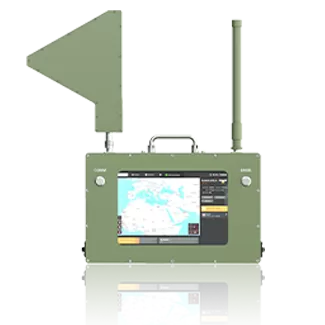
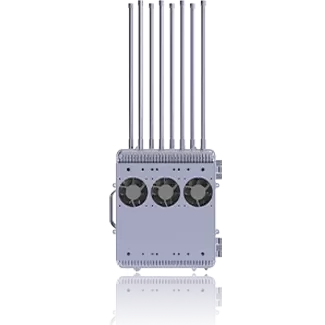
With more than a decade of experience in SDR technologies, Fsain Technology has incorporated a fully software-defined architecture into its Ares J11 jammer system.
Designed for demanding low-altitude security scenarios, J11 leverages SDR technology to deliver:
Wideband signal generation from 20 MHz to 8 GHz;
High channel concurrency and integrated broadband power amplifier architecture;
High-performance broadband antennas optimized for wideband operation;
Flexible frequency configuration and scalable system capabilities.
These characteristics enable J11 to provide reliable and adaptable RF mitigation performance across airports, ports, border security, critical infrastructure, and major event protection applications.
References
Additional Portable Anti-Drone Devices